Picture Perfect at Burton Constable
William and Winifred – the Hidden Meanings of a Masterpiece
When William Wilberforce ran for election in 1780, his campaign cost him a tidy £8,000. Today, this would be worth about £690,000! Only 10 years earlier, William Constable and his sister Winifred spent the same on their Grand Tour of Europe (1769-71).
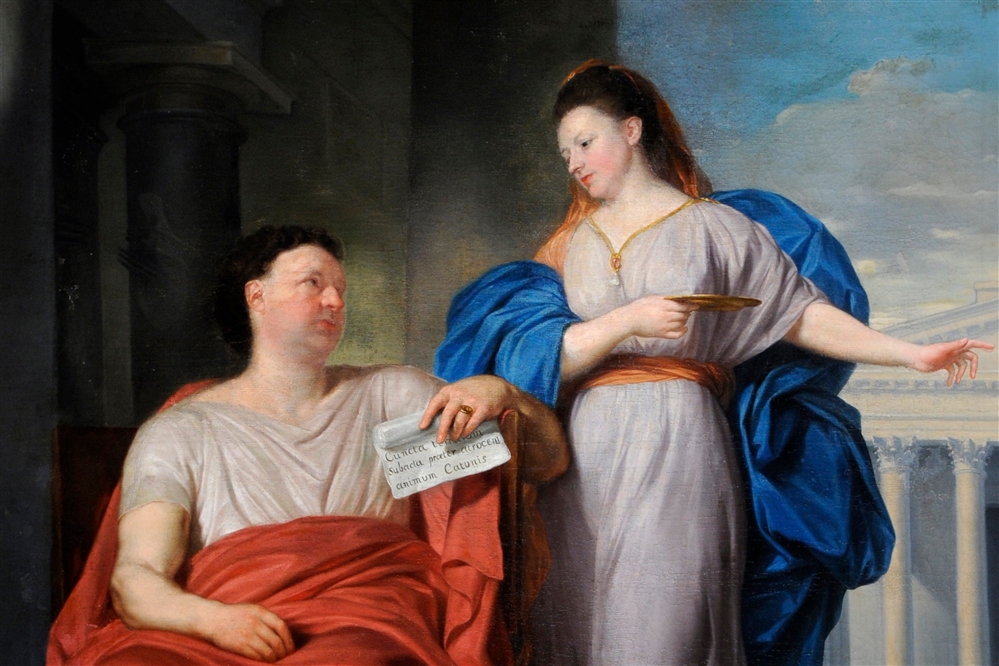
William ordered this double portrait of himself and his sister towards the end of the Tour, while staying in Rome. For this memento of their visit and statement of status, he commissioned Austrian court painter Anton von Maron (1733-1809) who had made a good living painting other notable Tourists such as Sir William Hamilton.
Although commissioned and painted in Rome, only the preliminary sketches were finished during their stay. The final work, together with a smaller version (now lost) was shipped to Burton Constable in 1774. Sadly, it arrived shortly after Winifred’s death, when William was inconsolable.
A Man of the Enlightenment
William was dogged by ill-health, referenced by his seated position in the portrait. His wheelchair can still be seen at the Hall. A man of the Enlightenment, William described himself as “a bit of a Vertu” – a gentleman (vertuosi) distinguished from the hoi polloi by his tasteful collecting and love of learning for its own sake.
William’s trip across the Continent was characterised not only by his quest for a remedy to his illnesses, but also by a desire to meet with some of the foremost minds of the Enlightenment period, such as Genevan philosopher Jean-Jacques Rousseau.
Classical Fashion & Political Statements
Von Maron’s painting depicts William and Winifred as the Roman statesman Marcus Porcius Cato (95-46 BC) and his wife Marcia. William identified with Cato, a highly principled, stubborn Republican of moral integrity who fought against bribery and corruption.
William would also have felt like an outcast in society. He and his family were staunch Roman Catholic recusants. As such William was denied the opportunity of public office by the Penal Laws following the Jacobite rebellions. The poignant inclusion of Cato’s ‘fasces’, abandoned in the bottom right of the painting, echoes William’s powerlessness in the political arena.
…or not?
An alternative interpretation of the work, suggested by Ivan Hall, is that William was poking fun at himself. A small statuette – a miniature version of a Vatican sculpture of the Greek comic poet Menander – is sometimes on show beneath the portrait itself in the Great Hall. The poet appears in an uncannily similar pose to that of William in the painting.
But in the end, this stunning painting tells its own story: a masculine and defiant William, albeit weakened; a caring, loving Winifred, supportive in his illness; and finally, the contrast between light and shade, caught in the folds of the dramatically depicted robes – typical features of allegiance to Roman Catholicism in Baroque art.