The Chichester Constable Family at War
Curator Philippa Wood revisits a past exhibition for Remembrance Day, looking at what war brought to Burton Constable.
Though sheltered in the quiet countryside of Holderness, Burton Constable and the family who have lived here saw their fair share of action and anxiety through the First and Second World Wars.
Read on for more information about the roles of the Chichester-Constable family in both military and nursing capacities, the much closer danger posed by the bombing of Hull, and the damage caused to Burton Constable itself by stray bombs. Discover how evacuees were sheltered on the estate and how members of the British Army were billeted in the Hall and parkland.
War on the scale of the Great Wars of the early twentieth century leaves very little untouched – and still has an impact on people and families today.
Lest we forget.
Home and Away
The Edwardian country house was a place of extravagance, pleasure and sharp social contrasts. The elite classes enjoyed a lavish lifestyle of ‘social seasons’, while domestic and agricultural workers depended upon country house estates for their livelihoods; everyone knew their place.
The outbreak of the First World War in 1914 was the pin that burst the bubble, bringing an abrupt end to this ‘cotton wool’ and ‘tea on the lawn’ existence and sending shockwaves across every social stratum.
The Chichester-Constables: A Family at War
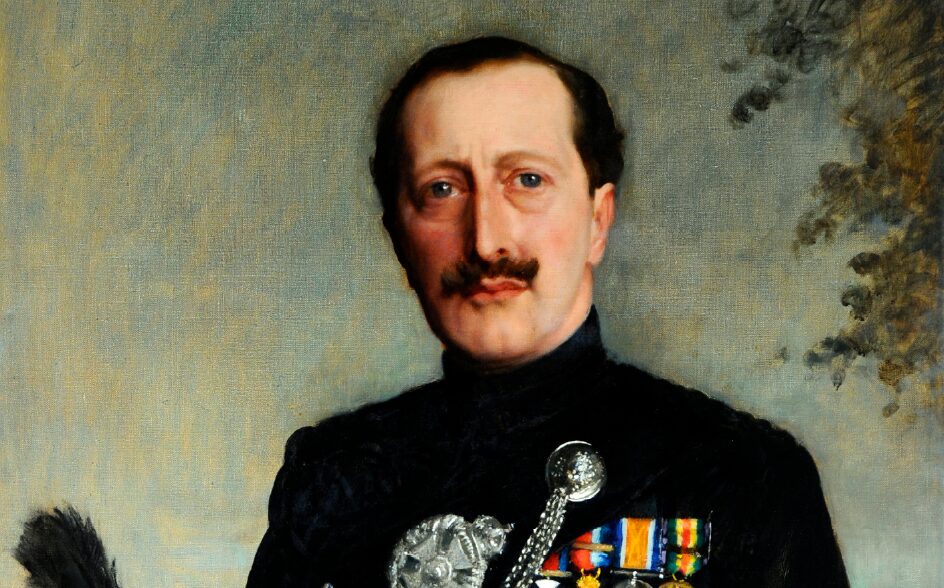
Lieutenant Colonel Walter George Raleigh Chichester-Constable saw action in the First World War, along with his six children. Sons Cecil, Raleigh and Basil all served in the Army, while daughters Edith, Blanche and Violet served with the Voluntary Aid Detachment (VAD); their names can be seen on the Sproatley War Memorial.
It is a remarkable statistic that all seven family members returned alive. Sadly, this could not be said when the family once again found themselves involved in the Second World War.
Raleigh and Gladys: Love, Honour and Obey
Raleigh Charles Joseph Chichester-Constable met Gladys Consuelo Hanley after gate-crashing her ‘coming out’ ball at the family’s London home. They soon fell in love and, with the outbreak of war in 1914, expressed their desire to marry.
Against the backdrop of heavy losses on the battlefields, their intentions were opposed by Mrs Hanley, who declared that she did not want a “six-week son-in-law”; such was the life expectancy of a young officer at the time.
Raleigh and Gladys embarked upon a long romantic correspondence throughout the war. Raleigh was destined to become a distinguished soldier, while Gladys volunteered with the VAD. They eventually married in 1917.
Gladys Consuelo Hanley: An Angel at the Front
When war broke out in 1914, women of all classes were anxious to help in any way they could. Many joined the Voluntary Aid Detachment (VAD), serving as nurses and drivers and assisting the injured and dying.
Gladys served at Villars, Poissy, with the French Red Cross and at the Edinburgh and Border Hospital in Dunkirk. She would have witnessed horrific scenes and dealt with conditions entirely alien to a woman of her background. Letters home describe convoys of pitiful men, their bandages stiff with mud and blood, their suffering eased only by kindness and the daily dole of cigarettes and matches.
Many women were forced to resign from their posts because of ill health, as was the case with Violet Chichester-Constable. Gladys eventually returned to England after finally being granted permission to marry Raleigh.
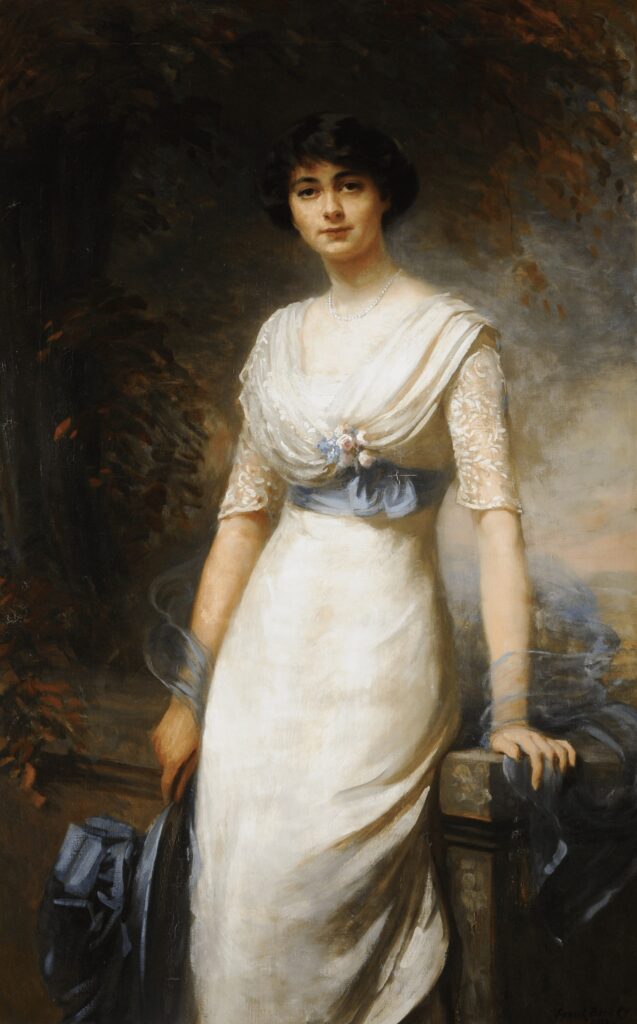
She was awarded the British War Medal and the Victory Medal in recognition of her service.
Brigadier Raleigh Charles Joseph: A Leader of Men
Raleigh was a career soldier serving in India, but on the outbreak of war in 1914 he returned to England and was posted to France with the 2nd Battalion, Rifle Brigade.
He was wounded six times, Mentioned in Despatches four times, and awarded the Distinguished Service Order (DSO) on 14 January 1916. It is believed that he received the DSO for enabling a ‘special advance’ at Neuve Chapelle by taking men forward to blow a way through German barbed wire while illuminated by enemy star shells. Two NCOs also received the Victoria Cross for their bravery.
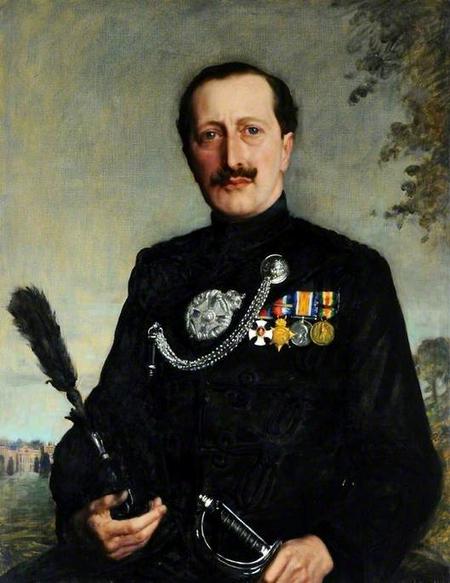
Raleigh was also one of only two officers who survived the Battle of Aubers Ridge, despite having been wounded earlier in the day. The battalion suffered enormous losses, with many men killed, wounded or taken prisoner.
Raleigh was forced to leave the Army in 1923 to help run the family estate, but he returned to service during the Second World War, commanding brigades in North Africa and during the Dunkirk campaign. Returning to England “by the skin of his teeth”, his leadership earned him promotion and a Bar to his DSO.
Cecil
Cecil’s war required a different kind of bravery. On 27 August 1914, only six days after arriving in France with the Royal Warwickshire Regiment, he was captured and spent the next four years incarcerated as a Prisoner of War. Cecil attempted numerous escapes and was awarded the Military Cross for his “gallant conduct and determination”.
However, his actions also resulted in a death sentence. Family stories tell of him refusing a blindfold and calmly taking an apple from his pocket when the time came to face the firing squad. His composure impressed the German officer in charge, who commuted the sentence to eighteen months in solitary confinement.
When he was released at the end of the war, Cecil was so emaciated that his mother did not recognise him. He vowed never to be taken prisoner again.
Cecil’s experiences during the First World War influenced his attitude when war broke out again in 1939. By then a Major, he was Mentioned in Despatches in 1940 for his “sustained courage” at Grindorff, France. At Wormhout, he led his men from the front carrying only a pistol and was last seen alive manning a Bren gun, preferring to die in action rather than be captured again.
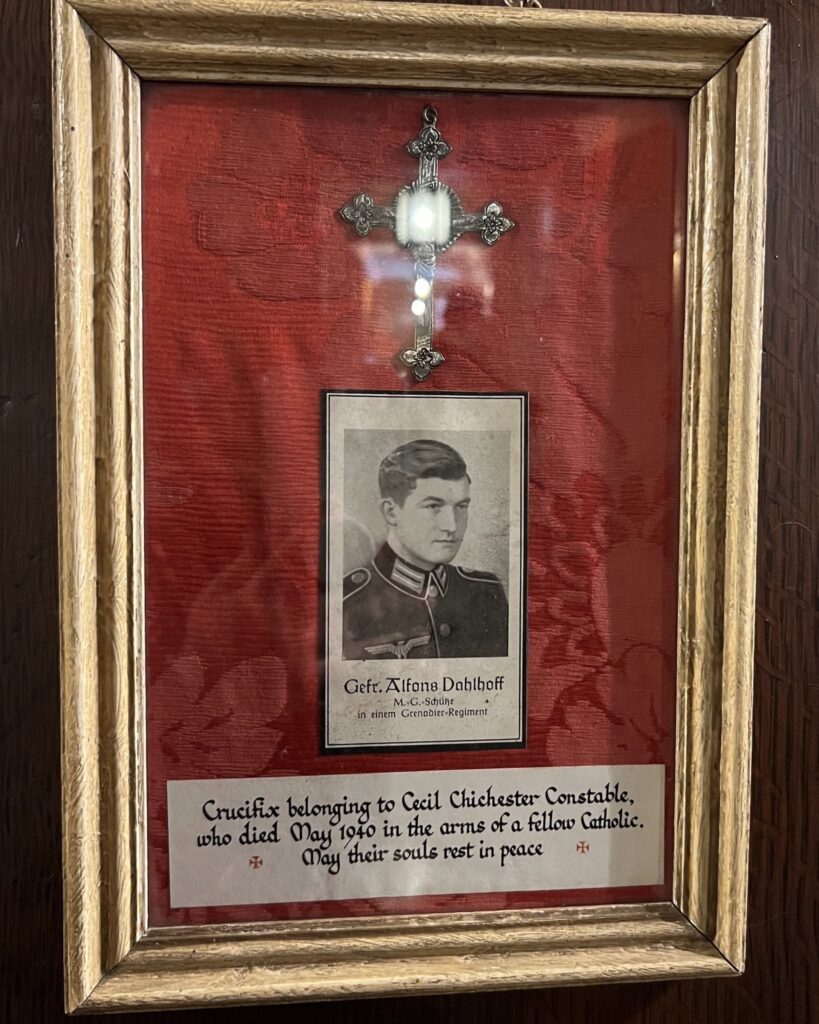
Cecil’s faith gave him strength at the time of his death. He was attended by a German Lance Corporal who was also a fellow Roman Catholic. Alfons Dalhoff took charge of Cecil’s final letter and crucifix, promising to send them home. After the war they did indeed arrive at Burton Constable, although sadly Alfons too lost his life in the conflict. The crucifix can still be seen on display in the Chapel at the Hall.
Basil
The youngest of the three brothers, Basil’s military career and personal life were somewhat chequered. In 1914 he was appointed as a 2nd Lieutenant in the East Riding of Yorkshire Yeomanry. In 1916 he enlisted with his father’s regiment, the 1st Battalion, King’s (Liverpool Regiment), as a private soldier.
Although he was quickly promoted to Corporal, after serving only a month on the Western Front he was wounded in action and transferred to the Army Service Corps, where he served at the Army Service Corps Remount Depot at Kettering.
Basil’s severe facial injuries caused significant psychological trauma. His attempts to distract himself during the inter-war years caused concern within the family, reflecting the limited understanding of mental health issues at the time.
During the Second World War, Basil rejoined the Army as a Lieutenant. However, his post-traumatic stress continued to affect his behaviour, to the detriment of his military career. In 1941 he was dismissed following a Court Martial. Despite this outcome, wartime conscription meant that he remained in the Army and served with the Dorset Regiment until the end of the war.
The Mental Impact of War
Cecil
Cecil’s capture as a Prisoner of War came early in the First World War, resulting in four and a half years of incarceration. He believed it was his duty as an officer to be a difficult prisoner and to attempt escape whenever possible.
“It is reported that on one occasion he threw an ashtray at a German officer. This act resulted in an order for his execution by firing squad. At the appointed hour he refused a blindfold and, unlike a Russian officer who broke down in tears before he was executed, Uncle Cecil took an apple from his top pocket, smiled at the firing squad and ate it. I think the German officer was so impressed by his composure that the death sentence was commuted to solitary confinement, where he remained for eighteen months until the end of the war.”
Raleigh travelled to London with his wife Gladys to bring Cecil home at the end of the war, searching the warehouse where returning soldiers were being sheltered.
They searched in vain until only one elderly man remained, huddled in a corner wrapped in a greatcoat, who called out, “Hello, Raleigh.”
It was Cecil. He was virtually unrecognisable because of the hardships he had endured in the prison camps.
Cecil returned home, but he was never quite the same. His wartime experiences left a lasting scar and he became something of a recluse. He spent much of his time alone in the North Tower, researching the family’s history and organising its archives.
When the Second World War broke out, however, he once again returned to the front line to serve his country.
Basil
The family struggled to understand Basil’s behaviour following the war. His appearance had been significantly altered by shrapnel injuries, and he moved from one pastime to another in an effort to distract himself from his wartime experiences.
As these pursuits included gambling, and because he left his wife, he became regarded as the family’s “black sheep”, despite the fact that much of his behaviour stemmed from the psychological effects of his wartime trauma.
Horsepower vs Pedal Power
War Horse
Following his wounding in 1916, Basil Henry Chichester-Constable served at the Army Service Corps Remount Depot at Kettering.
Horses were vital to the war effort. They were required by the cavalry, used to transport weapons and supplies, and employed to carry the wounded to medical facilities.
When war was declared, the Army possessed only 25,000 horses. The Remount Department was therefore tasked with obtaining approximately 750,000 more. Initially, landowners and farmers were required to sell their horses; later, animals were imported from across the world.
The conditions endured by soldiers in the trenches are well documented, but horses suffered terribly too, struggling to pull heavy loads through thick mud while becoming accustomed to the constant noise of warfare.
One soldier described the experience as:
“Mud, sleet, ice, mud, noise, jagged steel, mud, horror piled upon reeking horror.”
Although the Army lost around 15% of its horses each year during the war, only a quarter of these losses were due to enemy action. Most animals died from exposure, starvation, disease or exhaustion caused by the dreadful conditions they endured.
The First World War was the last conflict in which horses were used on such a vast scale.
With barely time to recover from the horrors of the Great War of 1914–1918, the outbreak of the Second World War in 1939 once again called troops to the battlefield and transformed life on the Burton Constable estate.
Although Raleigh Chichester-Constable’s Army career had ended abruptly in 1923 when he was asked to help manage the estate, he continued to take a keen interest in military affairs. He also established a cricket pitch on the west side of the Hall; unfortunately destroyed by bombing during the Second World War.
Raleigh and Gladys made their home in the family’s nearby dower house. However, when war broke out, Raleigh re-enlisted at the age of forty-nine. Management of the estate was entrusted to “Old Harry” Caley, a trusted tenant farmer and landowner.
“The estate did not return to its status quo until 1945, when Raleigh came back from the war.”
During the Second World War, Raleigh commanded a brigade and saw action in North Africa until 1943, when he was recalled to the Home Front. His duties took him across many theatres of war, and he was among those evacuated from Dunkirk with the British Expeditionary Force.
“There is one particular tale of him directing the evacuation whilst standing in a boat. He lost his balance and fell into the sea. Because he was wearing boots they quickly filled with water and he almost drowned, but luckily someone pulled him to safety.”
Raleigh’s brother Cecil had also returned to the Army during the Second World War. His years as a Prisoner of War during the First World War led him to vow that if he ever found himself involved in another conflict he would never again allow himself to be captured.
He fought courageously and kept that promise, defending the retreat of his men with a Bren gun until he was killed in action.
An Estate at War
Whilst Raleigh Chichester-Constable fought at the front, he entrusted the running of the estate to Harry Caley, who had purchased farmland from the Burton Constable estate after the First World War. Whilst the land was in safe hands, the same could not be said for the Hall.
Army Occupation
It was said at the time that “the British Army did more damage to the Hall than the Germans”.
As was the case with many country houses, Burton Constable was occupied by various Army regiments during the Second World War, at a time when it stood empty. Following financial difficulties during the inter-war years, the family had been forced to cover the contents with dust sheets and relocate.
In 1940, following the Dunkirk evacuation, the stables were occupied by the Royal Engineers, whilst the Worcestershire Regiment used the house and parkland. Companies camped beneath the trees; the kitchen became the battalion cookhouse and the Great Hall their dining room. The more fortunate officers occupied the whole of the South Wing as their mess and quarters.
The lack of respect shown to the property is demonstrated by a gunshot wound still visible in a painting hanging in the Great Hall.
Danger from the Skies
The rise of aerial warfare brought danger from above, and Burton Constable’s proximity to the coast placed it directly beneath the flight path of German bombers attacking Hull.
It is unlikely that the Hall was a designated target, but aircraft returning to base often jettisoned their remaining bombs, and Burton Constable would have appeared from the air to be an important building.
In May 1941, two parachute mines were dropped, narrowly missing the Hall and stable block. The resulting blast caused significant damage to the Orangery and shattered most of the windows on the Hall’s west front, destroying some 2,000 panes of glass.
In 1941, the Government established a War Damage Insurance Scheme, to which Burton Constable subscribed. Various claims were submitted throughout the war, though compensation was never paid. The Government’s explanation was that all available manpower and building materials were urgently required for the war effort.
Safety at the Stables
As well as providing temporary accommodation for the Army, the stable block at Burton Constable became a refuge for families fleeing bombing raids and a secure storage location for valuable commodities.
The Lister family from Hull made their home in a room above the stable block, which was then being used as a store. The building housed peanuts and printing paper as part of the war effort, providing a temptation for local children, who would climb in and help themselves to nuts.
Despite many children being evacuated to Burton Constable for safety, one child was a notable exception. Although the Hall was his home, John Chichester-Constable was evacuated elsewhere because of his mother Gladys’s fears that the Luftwaffe had earmarked their nearby home as a target.
Gladys was not entirely without reason for concern. The Orangery and the windows of the Long Gallery were badly damaged by a bomb that fell in the West Park during the war. This was most likely the result of German bombers dropping their payloads in haste as RAF fighters closed in.
The Orangery was not restored until Burton Constable received a Government grant in 1965.
The People’s War
Burton Constable, its surrounding farmland and its people all played their part in the war effort. Grassland around the Hall was ploughed up and converted to cereal and potato production as part of the national ‘Ploughing-Up Campaign’.
Local people and newcomers alike worked together to support the war effort, whilst children witnessed bomb blasts and barrage balloons overhead.
Dig for Victory
Agricultural workers were exempt from military conscription, although many still volunteered for service. Teams of Land Girls came from Hull to support local farms, undertaking demanding physical work such as ploughing and threshing.
German and Italian Prisoners of War were also employed in agricultural work. Some travelled daily from POW camps, whilst others were billeted on individual farms.
Surprisingly, attitudes towards the prisoners were often friendly rather than hostile. After the war, some chose to remain in the area, forming lifelong friendships and even marrying local people.
A Safe Refuge
One fifth of Hull’s children were evacuated to rural areas during the Second World War. Whilst the Holderness countryside remained at risk from aircraft returning from bombing raids, it was still considered considerably safer than the city.
Numbers at village schools increased dramatically with the arrival of evacuated children, whom local residents sometimes remembered as being “alive with lice”.
Defending Holderness
As part of Britain’s east coast, Holderness was vulnerable to enemy attack. Decoy docks were constructed at Cherry Cobb Sands to protect the Port of Hull, whilst anti-aircraft batteries were stationed at Ellerby.
RAF airfields at Leconfield, Catfoss, Hutton Cranswick and Driffield meant that there was almost always activity in the skies overhead.
Dad’s Army
Like communities throughout Britain, villages across Holderness formed Home Guard platoons. Men in reserved occupations, those considered too old for military service, and occasionally those who were underage formed a vital first line of defence against any enemy invasion.
The platoons had their own bases and equipment, including Battle Dress uniforms and Sten guns. They trained at Rolston Camp, Hornsea, and Chatt House, Burton Pidsea, which had been requisitioned for the purpose.
Farm worker George Charlton was only fourteen when he joined the Home Guard; the local recruiting officer simply altered his age to sixteen. George later recalled training at the Rolston firing range and the excitement of receiving his uniform, rifle and live ammunition.
The Last Military Chichester-Constable
John Chichester-Constable left Eton in 1944–45 feeling highly patriotic. The war was still ongoing, and he decided to join the Army, following in his father’s footsteps by serving in the Rifle Brigade.
In 1945 he was stationed in Germany and spent some time working on the clear up Bergen-Belsen concentration camp after liberation. The war soon ended, however, and peacetime Army life involved extensive training, both military and mechanical, together with fitness and driving instruction.
These opportunities allowed John to develop his talents in athletics, reaching Olympic-standard running performances, and in motor racing, eventually competing in TT races.
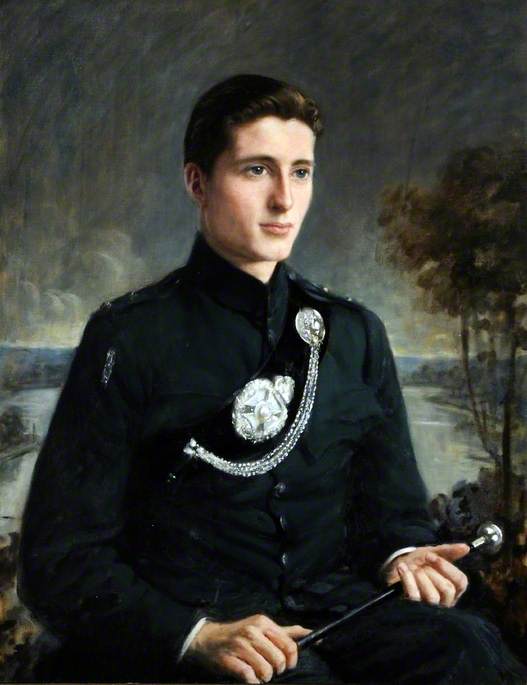
In time, however, he returned to Burton Constable to learn the management of the family estate and continue their efforts to preserve Burton Constable Hall for future generations.